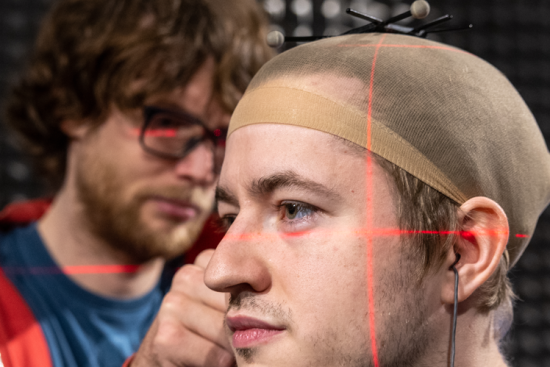
Aidan Hogg has been awarded a New Investigator Award worth £637,360 by the Engineering and Physical Sciences Research Council (EPSRC). The project, titled “Spatial Hearing Augmentation to Improve Hearing Assistive Technology,” will investigate how artificial spatial cues can be used to improve the way people with hearing loss understand and navigate complex acoustic environments. The project includes collaboration with partners at Imperial College London and Eargym Ltd.
Spatial hearing is essential for everyday life. It helps people locate sounds, follow conversations in noisy places, and maintain awareness of their surroundings. However, for many users of hearing aids and other hearing assistive technologies, spatial hearing is significantly degraded. Although hearing aids can amplify sound, they often distort the spatial cues that listeners rely on to separate sound sources and judge direction, especially when using beamforming and other noise-reduction algorithms.
The project proposes a new approach. Rather than relying solely on AI to decide which sounds to suppress or amplify, it will explore how AI can enhance spatial cues themselves. This will be done by developing optimised “superhuman” head-related transfer functions (HRTFs) derived from virtual ear shapes that exaggerate spatial filtering effects beyond those observed in natural human anatomy. The aim is to help users localise sounds more accurately, improve speech understanding in noisy environments, and regain a greater sense of autonomy and situational awareness.
Over three years, the project will create the first open-access dataset of superhuman HRTFs, use machine learning to optimise them for behavioural tasks such as localisation and speech-in-noise understanding, investigate how well users can adapt to these enhanced cues through training, and evaluate their performance against current hearing-aid approaches in realistic listening scenarios. The work will support a full-time PDRA for three years and contribute to the development of a new research strand in spatial hearing augmentation and perceptual interfaces.
The longer-term vision is to establish a new perceptually driven framework for hearing assistive technology: one in which intelligent systems not only restore lost function but also actively augment perception by helping listeners make better use of spatial information. Beyond conventional hearing aids, the research could inform future hearing technologies such as AR audio platforms and spatial hearing glasses.
Spatial hearing is essential for everyday life. It helps people locate sounds, follow conversations in noisy places, and maintain awareness of their surroundings. However, for many users of hearing aids and other hearing assistive technologies, spatial hearing is significantly degraded. Although hearing aids can amplify sound, they often distort the spatial cues that listeners rely on to separate sound sources and judge direction, especially when using beamforming and other noise-reduction algorithms.
The project proposes a new approach. Rather than relying solely on AI to decide which sounds to suppress or amplify, it will explore how AI can enhance spatial cues themselves. This will be done by developing optimised “superhuman” head-related transfer functions (HRTFs) derived from virtual ear shapes that exaggerate spatial filtering effects beyond those observed in natural human anatomy. The aim is to help users localise sounds more accurately, improve speech understanding in noisy environments, and regain a greater sense of autonomy and situational awareness.
Over three years, the project will create the first open-access dataset of superhuman HRTFs, use machine learning to optimise them for behavioural tasks such as localisation and speech-in-noise understanding, investigate how well users can adapt to these enhanced cues through training, and evaluate their performance against current hearing-aid approaches in realistic listening scenarios. The work will support a full-time PDRA for three years and contribute to the development of a new research strand in spatial hearing augmentation and perceptual interfaces.
The longer-term vision is to establish a new perceptually driven framework for hearing assistive technology: one in which intelligent systems not only restore lost function but also actively augment perception by helping listeners make better use of spatial information. Beyond conventional hearing aids, the research could inform future hearing technologies such as AR audio platforms and spatial hearing glasses.